I blinked and it’s December 2025! What is going on?
Do you feel like you’re caught in a whirlwind of activity and hoping to land at some point in a quiet, serene, joyful space to decompress and relax?
And BOOM before you know it – it’s winter and it’s snowing and we’re freezing and shoveling and on and on and on. Well, that’s true if you are in Canada or another cold country, but you know what I mean.
Education…Amiright?
Whoa, what’s with the sudden shift in topic- sorry, I have ADHD. It is so liberating to just own it and claim it! I can finally be proud to say, I couldn’t help it and just let it flow!
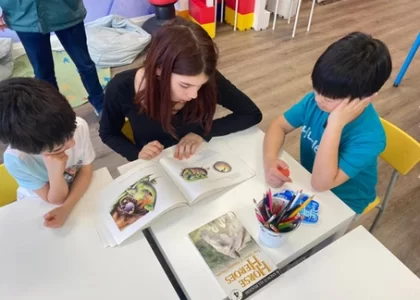
We have a lot to catch up on – but first – how cute are my students? Be honest? Right?!
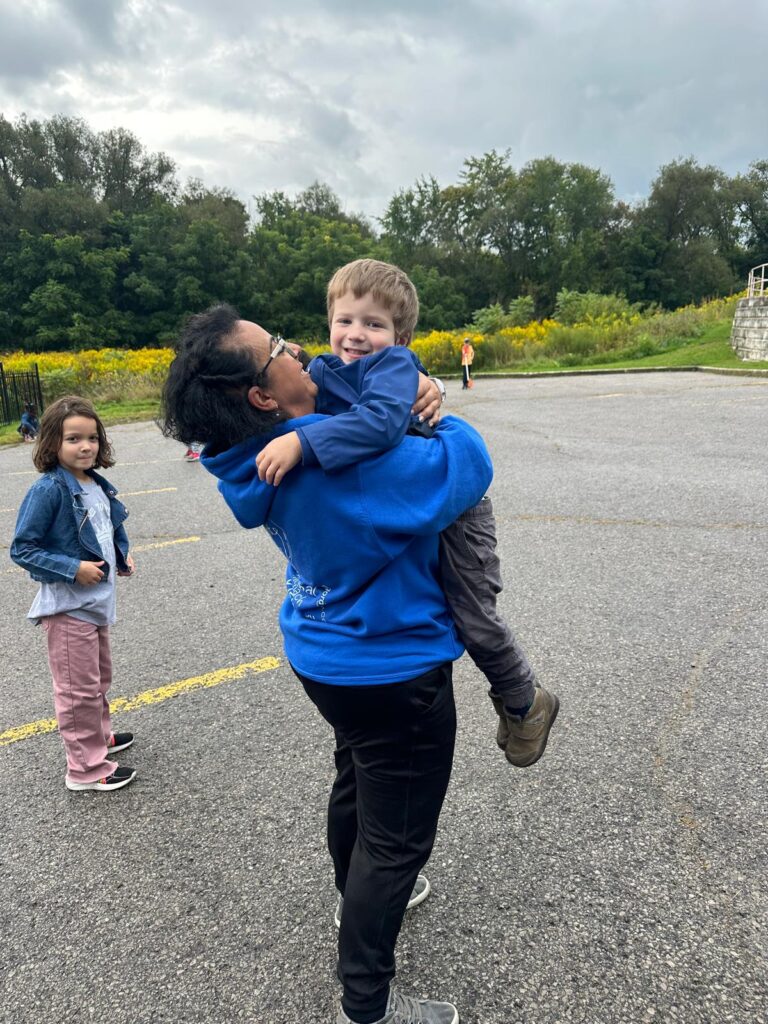
Do I have the best job ever?
Yes. Yes, I do.
Do I get loads of hugs per day?
Yes. It’s incredible!
Do I experience doubt and fear that I may not be able to continue my journey of owning my own private school for children of ALL ABILITIES?
Yes, I am plagued with doubt and fear.
Do I ever feel like giving up?
Of course! It is so hard. Sometimes you feel like an island on your own, with few who know you and even fewer who understand you.
Does it suck?
Yup. But you know what…it is WORTH every struggle, every tear, every risk I have ever taken.
So what does owning an academy for superpower children look like?
It’s a windstorm of activity. An avalanche of emotions and an ongoing uphill battle for equality, equity, inclusion, and true celebration of children who are a gift to this world.
If you are wondering, am I really interviewing myself?
Yes. Yes, I am. It’s a reflection or introspection and like it or not, you’re on the journey with me!
So what are some of my biggest critics saying about Agora Prep Academy?
I have chosen to believe, inherently because of the way I am raised, and due to extensive research with psychological studies performed (my background is Psychology & Education) that children are most vulnerable in their former years.
Reifen-Tagar (2022) argues that basic building blocks of ideology (group-orientations, moral judgments, in-group/out-group cognitions) appear in early childhood and can shape later political attitudes. This means that “ideological tendencies” have roots in elementary-age social cognition.
Willoughby et al. (2021) synthesizes evidence that parents are primary transmitters of political attitudes and that parental cues significantly influence children during late childhood (roughly ages 8–12).
These are just two examples of peer-reviewed, psychological studies about the former years bearing a tremendous significance on child-development.
With this established, I want to delve deeper into a controversial and almost, taboo, subject – teaching children about gender identity at a young age. I have released some videos on our Agora Prep Instagram Page that speak to this topic. I have been vilified and disrespected for my opinion on this and yet I continue to believe what I believe.
So what does Science state about this matter?
1. Young children do not yet have a fully developed prefrontal cortex
The prefrontal cortex — responsible for executive functioning, long-term planning, and complex self-concept — continues to develop until the mid-20s.
- Executive function skills (inhibition, flexible thinking) develop gradually through childhood (Diamond, 2013).
- Abstract reasoning abilities become more stable around ages 11–12 (Keating, 2004).
Implication of this:
Children in early elementary grades cannot process abstractions or long-term identity decisions the way adolescents or adults can.
2. Gender identity in early childhood develops naturally
Research shows children begin forming a basic sense of gender around ages 2–6 — but this is categorical, not conceptual:
- By age 3–7, children understand gender categories (Martin & Ruble, 2010).
- Their thinking is still rigid (gender stereotypes are extremely common at this age).
- They often misunderstand that gender can be independent of clothing or roles.
Implication of this:
Children at this stage are extremely literal. Presenting complex or fluid gender concepts too early may cause confusion because it exceeds their cognitive stage of development.
My heart tells me that we need to teach our children to accept, embrace, and love everyone for any life decision they make for themselves. We teach complete respect from members of all diverse groups. Discrimination based on race, religion, gender orientation, beliefs, cultures, abilities is prohibited in the environment.
We let parents have those discussions with their children at home through the lens of their culture, religion, outlook, viewpoint, and upbringing. As a school, we need to be focusing on academic skills, science experiments, developing a healthy mind and body, as well as developing moral characteristics like honesty, integrity, compassion, charity, acceptance, love, tolerance – among many others.
Here is what gets me…and I am sorry if it sounds like a rant: I have sacrificed, compromised, invested, researched, depleted all my resources to build this school. I am entitled to my own beliefs. If someone does not agree with me, they are welcome and FREE to start their own school.
This academy is my livelihood. It means everything to me because I had the gift of witnessing miracles happen here. So before you start to antagonize me with your criticism, please know that I realize I am not fit for everyone’s needs. Be respectful. Just move on, there are hundreds of schools that can better align with your vision and beliefs.
And no matter who you are, and what this world is telling you – YOU ARE PERFECTLY and WONDERFULLY created. Perfect as you are. No need to change a darn thing about you.
You are loved.
You are amazing.
The world is better, because you are in it.
With love,
Sylvia Badwi, Principal
References
Diamond, A. (2013). Executive functions. Annual Review of Psychology, 64, 135–168. https://doi.org/10.1146/annurev-psych-113011-143750
Keating, D. P. (2004). Cognitive and brain development. In R. M. Lerner & L. Steinberg (Eds.), Handbook of adolescent psychology (2nd ed., pp. 45–84). Wiley.
Reifen-Tagar, M. (2022). Political ideology in early childhood: Making the case for… Political Psychology.
Willoughby, E. A., et al. (2021). Parent contributions to the development of political attitudes and civic engagement. [Journal].